
If you are working out how to build an email list from a small blog, the whole job comes down to four things: a signup form on your pages, one genuinely useful free thing to offer, a welcome email that arrives instantly, and a newsletter you can send on a schedule you can actually keep. Start on a free plan, expect the first fifty subscribers to take a few months, and let real replies guide the changes.
A small blog has one advantage over a big brand: you know your readers by name in the comments. Email is simply the version of that relationship that still works when search traffic has a bad month. Here is the setup I would build first, in the order I would build it.
Table of Contents
- What You Need
- How to Build an Email List from a Small Blog: Step-by-Step
- Common Mistakes
- Frequently Asked Questions
- How many emails does a small blog need before it should start an email list?
- Is it better to offer a lead magnet or simply ask readers to subscribe?
- Which email service is easiest for a small WordPress blog?
- How often should a new blogger send newsletters?
- Can I import an existing list from another email platform?
- Is buying an email list ever a good idea for a small blog?
- Conclusion
What You Need

Nothing here is expensive, and most of it is a decision rather than a purchase. Work through the list before you install anything.
- A blog that publishes something. Even a post every couple of weeks is enough. Visitors arrive from search and social, and the form needs somewhere to live.
- An email service with a usable free plan. Mailchimp, Kit (formerly ConvertKit), beehiiv, Substack, Buttondown, MailerLite and Ghost all have free entry points. Pick on the basis of whether you want a hosted newsletter or a list that sits beside your own site.
- One written promise. A single sentence describing what subscribers get and how often.
- One lead magnet. A checklist, template, spreadsheet or short guide that solves a small problem in under ten minutes.
- A signup form and a landing page. The form lives on the site; the landing page hosts the download.
- A sending rhythm you can sustain. Twice a month is a perfectly good answer for most part-time bloggers.
- Permission to email people. Nobody signs up for spam, and both CAN-SPAM and GDPR take consent and unsubscribe seriously.
Free tiers usually cover a blog at the stage you are at now, and the contact limits on free plans get trimmed from year to year, so check what the current terms are in 2026 before you commit to anything. Upgrade later, when the limit is genuinely in your way.
How to Build an Email List from a Small Blog: Step-by-Step
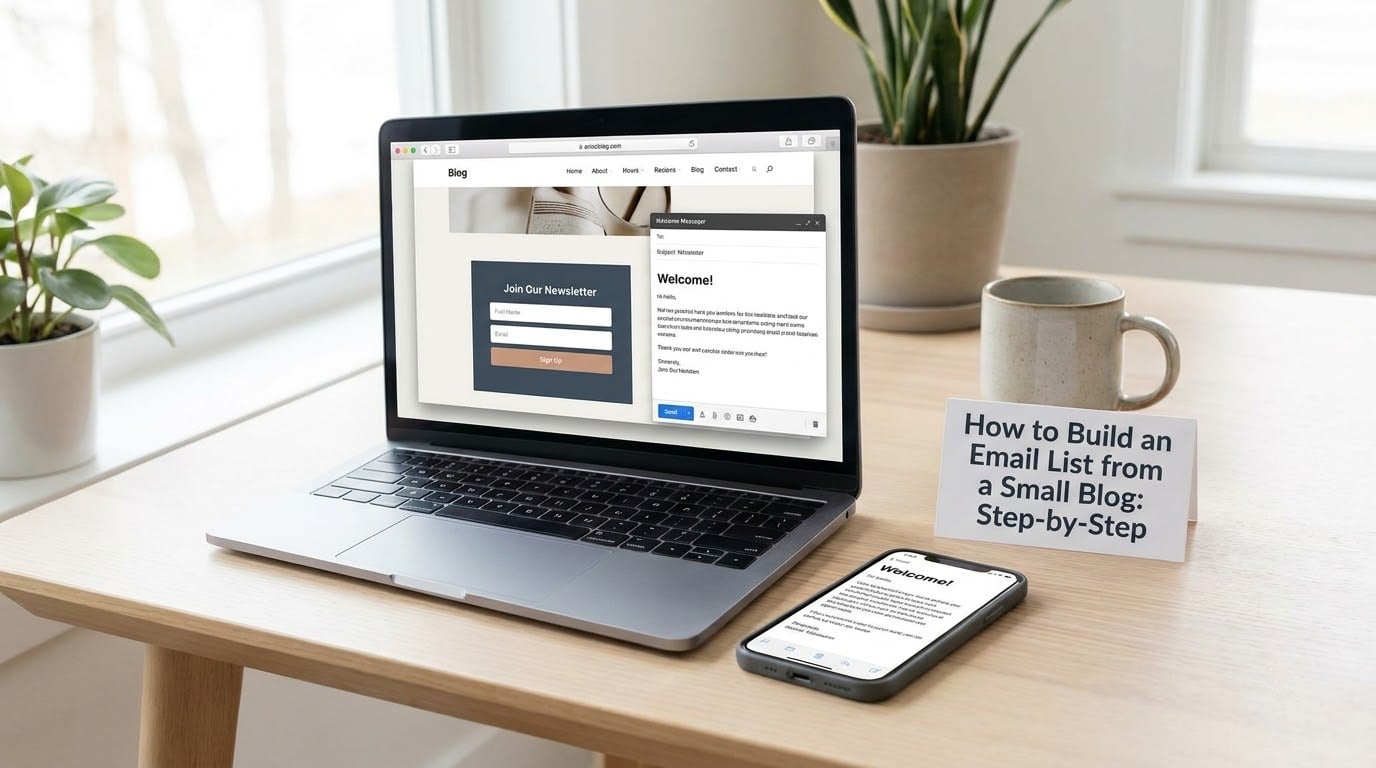
Seven steps. The order matters less than doing the first four before spending any time on design, because the design is not what makes people subscribe.
1. Define Your Audience and List Promise
Write down who actually reads your blog in one narrow sentence. “Freelance developers who need to ship client work faster” is workable. “Anyone who wants to blog better” is not, because nobody can picture themselves inside it.
Then describe the recurring problem your blog solves, in the reader’s words rather than yours. A good version sounds like something a commenter has already typed into your post: “I want to publish twice a month without losing a whole weekend to it.”
Turn that into the promise. Something like: “Every other Thursday, one short post on a workflow that saves an hour, plus the template behind it.” Write it where you can reuse it, because it belongs in three places: the top of the landing page, next to every signup form, and in the welcome email.
How do you know it works? Say your promise out loud to someone who has never seen the blog. If they can repeat it back roughly correctly, it is clear enough.
2. Create One Useful Lead Magnet to Build an Email List
The exchange has to feel fair to someone who has never heard of you. That rules out anything generic and anything enormous. The sweet spot is a resource that is useful on its own within ten minutes of opening it.
Ideas that fit small blogs well:
- A post-outline template pack, as a PDF
- A pre-publish checklist you genuinely use yourself
- A keyword research spreadsheet with the columns you actually track
- A swipe file of subject lines that worked, with notes on why
- A first-30-days subscriber plan for a brand-new blog
- A one-page audit sheet for a post you are about to publish
Skip anything that needs updating every month, and skip “the ultimate guide to blogging”. Specific and small converts better than ambitious and vague.
For the first ninety days you want exactly one of these. Two offers split your effort and your page’s message, and readers rarely pick between them.
3. Choose and Connect an Email Service
Check seven things before you sign up: the contact limit on the free plan, whether signup forms and landing pages are included, whether a welcome automation works on the free tier, whether you can import an existing list, what the analytics dashboard shows, whether there is a WordPress plugin, and whether you can send from your own domain address.
That last one matters more than beginners expect. Sending from a subdomain on your own domain, with SPF and DKIM records set up, is what tells receiving servers your emails are genuinely yours. These are standard DNS records the service generates for you and your domain host accepts; you paste them in, you do not write them. Without them your list can end up in spam folders, and no amount of good writing fixes that.
If you want a self-contained newsletter with its own URL, look at Substack, beehiiv or Ghost. If you want the list to live inside your WordPress site and support it, Mailchimp, Kit and MailerLite are the usual names. All of them are vendor-neutral choices worth comparing on current plan terms rather than on a recommendation from six years ago.
4. Add Signup Forms Where Readers Look
One form, offered in more than one place, always beats five forms competing. Here is roughly who sees each placement and what it tends to earn you:
- Homepage. Everyone sees it. Converts modestly, because visitors have not chosen a topic yet.
- End of a relevant post. The strongest per-view placement, because the reader just got value and the offer matches the page they are on.
- Site-wide footer or a slim bar. Sees every page, but the generic version converts poorly. Relevant wording fixes that.
- A resource page. Low traffic, high intent, and the form never gets in the way of anything.
- Your about page. Small, steady, and it converts well because trust is already established.
On wording, describe the benefit rather than the action. “Get the 12-template outline pack (PDF, 9 pages)” earns more signups than “Subscribe”, because the second one asks for effort without saying what comes back.
Keep the form visible on a phone without scrolling, and ask for an email address only. Every extra field costs you signups, and you can ask for more once someone replies to you.
5. Write a Welcome Email
Set up three emails as an automation so they send while you sleep. Keep each one short, under two hundred words.
The first fires immediately: confirm the signup, give the download link twice, say what you will send and how often, and ask for one reply with a question. That reply is the most useful data you will get all month. The second, two or three days later, points to your best post on the topic of the lead magnet and adds one honest sentence about why you wrote it. The third, a week in, restates the promise and points at your archive so the new subscriber has somewhere to click.
Turn on double opt-in if your platform offers it. Readers confirm their address by clicking a link, which shrinks your list slightly and keeps spam complaints near zero. For a list of a few hundred people, that is a trade almost everyone should make.
6. Send Newsletters Readers Actually Open
Choose a cadence you will still like at month six. Twice a month is the honest default for someone who also publishes posts. Weekly works if writing emails is the part of the week you enjoy, not the part you tolerate.
One email, one problem. Three hundred to six hundred words, up to five links, and a single call to action at the end: read this post, reply with your setup, forward it to a friend who has the same problem. Two competing actions means neither gets clicked.
Subject lines should be specific and plain. A line naming the exact problem outperforms a line announcing excitement, and it does so without the emoji trick that makes a feed look like spam.
Send the first newsletter even if five people subscribed. It sets the rhythm, and it is practice.
7. Track Growth and Improve the Process
Five numbers matter at this stage, and none of them are revenue:
- Signups per week. Trend over months, not days.
- Signup page conversion. Two to five percent of visitors is a normal range for a small blog; the end-of-post form often beats the homepage form.
- Open rate. Forty to sixty percent is normal for a small, engaged list.
- Click-through rate. Ten to twenty percent is healthy for a list this size.
- Unsubscribes and replies. Keep unsubscribes under roughly half a percent per send, and treat replies as the best signal you get.
Notice which posts produce signups rather than just page views, and use tagged links in your emails so you know where clicks land. Every six months, run a re-engagement campaign to people who have not opened anything in months, and drop addresses that bounce repeatedly. That habit, list hygiene, is what keeps a small list deliverable.
Treat all of this as input to the next experiment, not a forecast. Fifty subscribers who open your mail are worth more than five thousand who never saw it.
Common Mistakes
Nearly every stalled list I have seen came down to one of these six.
- Buying a list. Those addresses did not choose you, they bounce or complain, and your sending domain takes the damage. Fix: never. Growth that takes a purchased list is not growth.
- Promising more than you can send. “Daily tips” loses subscribers within a month. Fix: promise the lowest cadence you can sustain, then raise it only once you have proof you can.
- Asking for too much up front. Name, phone, company and preferences in one form ends most signups. Fix: email address only, then enrich the profile through replies and later updates.
- Hiding the form. A grey link in the footer is not a strategy. Fix: one form at the end of each post, repeated in the footer, relevant wording on every one.
- Sending irregularly. Readers forget you, then the sending domain looks spammy to the inbox providers. Fix: pick a date and keep it, even when the issue is thin.
- Skipping consent and the unsubscribe. A visible one-click unsubscribe and a record of how someone opted in are not optional extras. Fix: use double opt-in, keep a plain-text address and a date per signup, and never buy, scrape or swap lists.
With the basics in place, distribution is the slow part. Trade newsletter mentions with other small blogs in your niche, since a swap with a 300-person list is worth more to you than a post to 3,000 followers who never see it. Invite commenters to subscribe in replies to their questions, where the conversation already exists. Once you pass a couple of hundred subscribers, a simple referral offer works: extra something, or nothing at all beyond a thank-you note. Referral mechanics are worth automating later, not now.
Frequently Asked Questions
How many emails does a small blog need before it should start an email list?
None. You do not need a mailing list to start one. A blog with fifty regular readers can add a form today and collect its first ten subscribers this month. What you avoid is waiting for a traffic milestone that may never come, and delaying the welcome automation that does the persuading for you while you are busy writing posts.
Is it better to offer a lead magnet or simply ask readers to subscribe?
A bare signup form works fine when your posts already promise regular updates and readers want them. A lead magnet works better when you need something to promote in places other than your blog, such as communities and social posts. For a small blog, treat it as a promotion asset first and a conversion tool second, and keep only one at a time.
Which email service is easiest for a small WordPress blog?
Look for a WordPress plugin, a free plan that includes signup forms and a welcome automation, and the ability to send from your own domain address. Mailchimp, Kit, MailerLite, Buttondown, beehiiv, Substack and Ghost all qualify in some form. The easiest one is whichever you will actually connect on day one rather than evaluate for a weekend.
How often should a new blogger send newsletters?
Twice a month is the most sustainable starting point, and it beats weekly for most solo bloggers. Pick fixed dates, such as the first and third Thursday, and send even in months when you feel you have nothing to say. Readers forgive a thin issue far more readily than a missed one.
Can I import an existing list from another email platform?
Yes. Every major platform offers import, usually as a CSV file with email address, name and the date of signup. Import first, then turn on double opt-in for new subscribers and run a re-engagement campaign to confirm the older ones. Only import addresses people gave you permission to email, and keep your consent records.
Is buying an email list ever a good idea for a small blog?
No. Purchased addresses did not opt in, they bounce and complain, and the complaints damage the sending reputation of your own domain, which is the one asset you cannot easily replace. It also makes your open rates meaningless, so you lose the signal that tells you what readers want. Build slowly instead; a small list of real people outperforms a large borrowed one.
Conclusion
To build an email list from a small blog, you are assembling four pieces in order: one narrow audience, one written promise, one useful lead magnet, and one signup form that appears at the end of every post and in your footer. Then you automate a short welcome sequence, send on a fixed twice-monthly rhythm, and clean the list every six months.
Start this week. Pick the audience sentence, write the promise, choose the checklist you will actually give away, and connect a free plan to a form on your most-read post. Everything else on this list gets easier once those four exist.