
Yes, you can make money from a blog without ads. The ad-free routes are affiliate commissions, your own digital products, services and coaching, sponsorships, paid memberships, and licensing, and several of them start paying before you have ad-eligible traffic. The catch is that none of them pay for impressions alone, so you are trading passive per-pageview income for higher amounts per reader who actually acts.
That trade is worth understanding before you start, because display advertising is the one model that pays you for showing up. It also needs tens of thousands of monthly pageviews before the numbers matter, a chunk of that revenue disappears for anyone running an ad blocker, and the script-heavy widgets slow pages down. Bloggers who decide against ads usually end up with a faster site, a smaller but far more engaged audience, and revenue tied to trust instead of to traffic volume.
I run workreveal.biz without display ads, and this is the method set that actually works here. Below is the practical sequence: what you need first, how to pick a model, how to set each one up, and how to tell whether it is working. I have kept the money talk realistic on purpose, because the income screenshots floating around social media are the fastest way to lose trust with a beginner.
Table of Contents
- What You Need
- Ad-Free Blog Income Streams at a Glance
- Step-by-Step
- Step 1: Choose a Blog Niche and Audience
- Step 2: Build Trust Before Recommending Anything
- Step 3: Start With Affiliate Marketing
- Step 4: Sell Your Own Digital Products
- Step 5: Offer Freelance Services or Consulting
- Step 6: Add Sponsorships, Memberships, and Donations
- Step 7: Track Results and Improve Your Offer
- Common Mistakes
- Frequently Asked Questions
- Can a new blog make money without ads?
- What is the easiest way to monetize a blog without ads?
- Do I need a large audience to earn money from a blog?
- How long does it take to monetize a blog without ads?
- Should I disclose affiliate links and sponsorships?
- Do bloggers need a business license or pay taxes on blog income?
- How to Make Money from a Blog Without Ads: Start Here
What You Need
Everything below assumes six things. Miss one and you will spend months building something that cannot be monetized at all.
A defined audience and topic. Not a subject you find interesting, but a specific person with a specific problem. “Baking” is a hobby. “Weeknight dinners for two people who hate washing up” is an audience with buying decisions attached.
A content library or a publishing plan. Nobody buys a recommendation from a site with three posts. Twenty solid pieces on one narrow problem is the practical floor, and a consistent schedule matters more than volume after that.
An email relationship with your readers. Search traffic can shrink overnight, especially now that AI answers absorb a lot of informational queries. An opt-in list is the only audience asset you control outright, and it works as the top of every funnel in this guide.
A payment method set up and working. A payment processor account, a bank account in your own name, and a simple bookkeeping habit. Get this done before you make your first dollar so the money has somewhere to land.
Basic analytics. Your web analytics for traffic and behaviour, your affiliate dashboard for clicks and commissions, and a spreadsheet for revenue. Pageviews on their own tell you almost nothing.
A disclosure practice. A clear, visible statement wherever a commercial relationship exists, on every page that carries one. This is not optional and it is not negotiable in the US. Decide where the disclosure sits before the first paid link goes live, not after someone complains.
One honest note on what you give up by skipping ads. You lose an impression-based floor that pays while you sleep, and you lose the ability to monetize casual readers who came for a recipe and will never buy anything. In exchange you keep page speed and Core Web Vitals clean, your layout stays yours, and every dollar traces back to a person who chose to act. On most non-ad niches the second list wins.
Ad-Free Blog Income Streams at a Glance
Here is how the main methods compare. Time to first payment matters more than ceiling when you are starting from zero.
| Method | Traffic needed | Time to first dollar | Effort | Scalability |
|---|---|---|---|---|
| Services or consulting | Almost none | 2 to 6 weeks | High | Low, time-capped |
| Affiliate marketing | Low to medium | 1 to 3 months | Medium | High |
| Digital products | Medium | 1 to 4 months | Medium to high | Very high |
| Sponsored posts | Medium | 2 to 6 months | Low per deal | Medium |
| Memberships or courses | Medium to high | 3 to 9 months | High | High, recurring |
| Licensing content or photos | Any with a library | 2 to 6 months | Low after setup | Medium |
| Donations and tips | Any engaged audience | 1 to 2 months | Low | Low ceiling |
Step-by-Step
Step 1: Choose a Blog Niche and Audience
Write down one person, in plain words. Not a demographic, a person. A part-time nurse in her thirties who is tired of meal prep, wants fast weekday food, and will spend money on anything that saves her forty minutes on a Sunday.
Now list their urgent problems, ranked by how much they bother them. That list is your content plan and your product plan at the same time. Every post should attack one problem, and every income method later in this guide should solve one of those same problems for money.
Ask who benefits when that person gets what they want. If they buy something from someone else, you have an affiliate angle. If they need something made for them, you have a services angle. If they keep asking you the same question, you have a product. Choosing a niche is mostly choosing which of those three you can serve honestly.
How to make money from a blog without ads starts here, and it starts with a boring sentence: a narrow audience pays more attention than a broad one, and attention is what every later step converts.
Step 2: Build Trust Before Recommending Anything
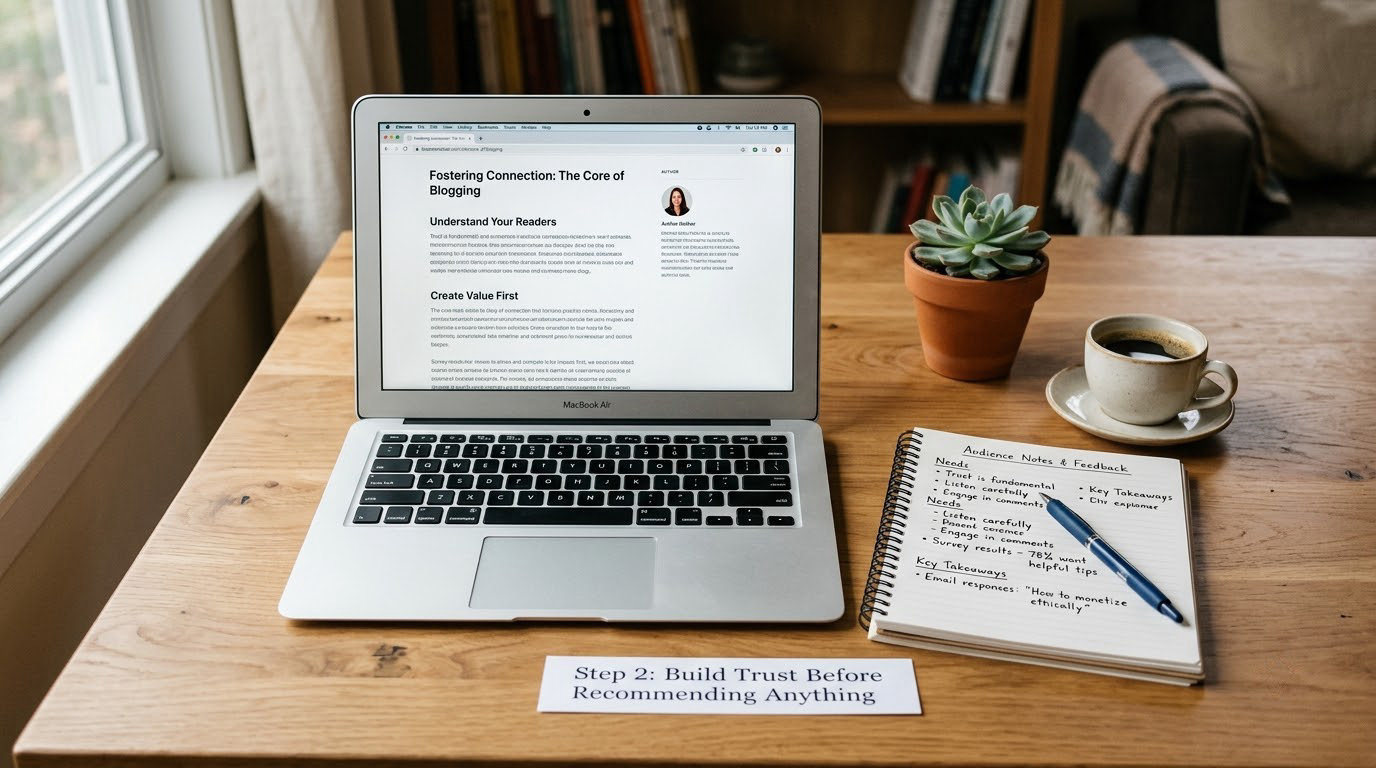
Trust is the product here. Everything else you sell is downstream of whether readers believe you when you say something works.
Publish things you used yourself and say how you used them. A post that recommends a blender because you made six smoothies in a week and hated five of the outcomes is worth more than one that recommends everything. Readers can tell the difference, and they reward the difference by buying.
Show your work where you can. Photos of your own setup, numbers from your own account, a photo of the spreadsheet. Real specifics are hard to fake and easy to verify, which is exactly the point.
Disclose before you are asked. Put a plain statement at the top of any page carrying an affiliate link, a sponsorship, or a product you made, and keep the link itself marked properly so search engines and readers both know. A disclosure costs you nothing and a hidden one can cost you the audience you spent a year building.
How to tell it worked: readers start quoting you back to you in comments and email, and someone asks which product you are using before you have offered anything. That is the signal to move on to Step 3.
Step 3: Start With Affiliate Marketing
Affiliate marketing means recommending someone else’s product and earning a commission when a reader buys. It needs no inventory, no support and no product writing, which is why it is the usual first move.
Pick programs that sell something your reader already wants. Approval is often easier than people expect, and the useful filter is relevance, not commission percentage. A high percentage on a product your audience does not buy produces nothing.
Use trackable links. Every program hands you a unique link or a code, and it is the only way to know which post produced a sale. Give each link its own UTM label so you can see the source later without guessing.
Watch the attribution window. Most programs credit a sale for a set number of days after the click, commonly around 30, and some cookies expire if the reader buys something else first. A reader who clicks on Monday and buys on Friday still counts. A reader who clicks on a phone and converts on a laptop usually does not.
Recommend like a person. Use the product, say what it did and did not do for you, and link it where it solves a problem the reader already has. Stuffing ten links into a paragraph reads like an ad and converts like one too.
The honest risk right now: AI answers are eating clicks on informational queries, and affiliate income depends on clicks. Bloggers on Reddit keep raising exactly this, with the common complaint that sessions held up while conversions fell. The workable response is to stop chasing informational keywords and write the posts that need a person: comparisons, roundups, gear picks, and anything where a reader is close to buying.
Expected volume per thousand sessions on a decent recommendation: a handful of clicks, one or two sales at most, so the arithmetic that matters is sessions multiplied by conversion rate multiplied by commission. That formula applies to every method here, and it is the honest way to set expectations.
Step 4: Sell Your Own Digital Products
A digital product is a file a reader pays for and downloads: a checklist, a spreadsheet, a template pack, a printable planner, a short ebook, a mini-course. Margin is close to the whole price, delivery is automatic, and there is no shipping to think about.
Find it by rereading your own posts and your inbox. If the same question keeps arriving, that question is the product. The best version of this is something you already made for yourself and then cleaned up.
Validate before you build. Put up a page describing the product, collect email sign-ups for a launch date, and see whether anyone actually joins. Ten sign-ups from people you know is a weak signal; twenty from strangers who found your post is a strong one. Building a product nobody asked for is the most common way beginners waste three months.
Keep the sales page simple. What it is, who it is for, what changes for the reader after they use it, a few real examples, a price, a guarantee, and a payment button. Baymard Institute research on checkout abandonment is one reason long multi-step purchase flows lose people, so cut the steps rather than adding reassurance paragraphs.
Platforms like Podia, Gumroad, Payhip and ThriveCart handle the checkout, delivery and receipts. Compare them on fees, refunds and whether they take a share, not on feature lists you will never touch.
Step 5: Offer Freelance Services or Consulting
This is the fastest route to real money on a brand-new blog, and most beginners skip it because it involves talking to people. It is also the most reliable.
Start with one service, not a menu. A 90-minute setup session. A review of their current setup. A monthly retainer doing the thing you already do well. Narrow offers sell; broad ones do not.
Price it against what the outcome is worth to them, not against your hourly rate in isolation. Then write a plain offer page: what you do, what they get, what it costs, what you need from them, and when it happens. Three paragraphs is plenty.
Put it in one obvious place, a services page linked from your main navigation and from the posts where the topic comes up. Then collect payment the normal way and send a simple written agreement, so both sides know the scope. Contracts for coaching and sponsored work are worth having before the first client, not after a disagreement.
Traffic requirements are almost zero. What you need instead is a post that demonstrates you can do the work, and one sentence asking for the sale. How to make money from a blog without ads is often just a clear offer attached to proven competence.
Step 6: Add Sponsorships, Memberships, and Donations
Once you have steady traffic, three more models become available and they behave very differently from each other.
Sponsorships and brand partnerships pay a flat fee for a mention, a review, or a piece of content you write. Build a media kit with your traffic, audience profile, engagement, past work and contact details, and add a rate card so you are not pricing by reflex. Give every brand a trackable link so you can report clicks and conversions, and be honest when a number looks weak. Newsletters often pay more than posts for the same audience, so sell both.
Memberships charge recurring monthly or yearly for access to something ongoing: a member area, a monthly template drop, a private newsletter, a community space. This is the model that turns one sale into predictable revenue, and it needs a reason to renew every month, not just a pile of old posts. Set expectations for what members get before you take money, because cancelling members is worse than never having them.
Donations and tips are the honest low-ceiling option. Some readers will simply tip because they got value from free work, and a clearly labelled tip jar captures it with no pitch attached. Do not build a plan on this and do not be shy about it either. Patreon and similar platforms sit in the same family, useful when there is a recurring format worth backing.
Pick the one that fits how your readers behave. If they arrive and leave, sponsorships pay best. If they subscribe and come back, a membership earns best. If they feel gratitude without a transaction in mind, tips work.
Step 7: Track Results and Improve Your Offer
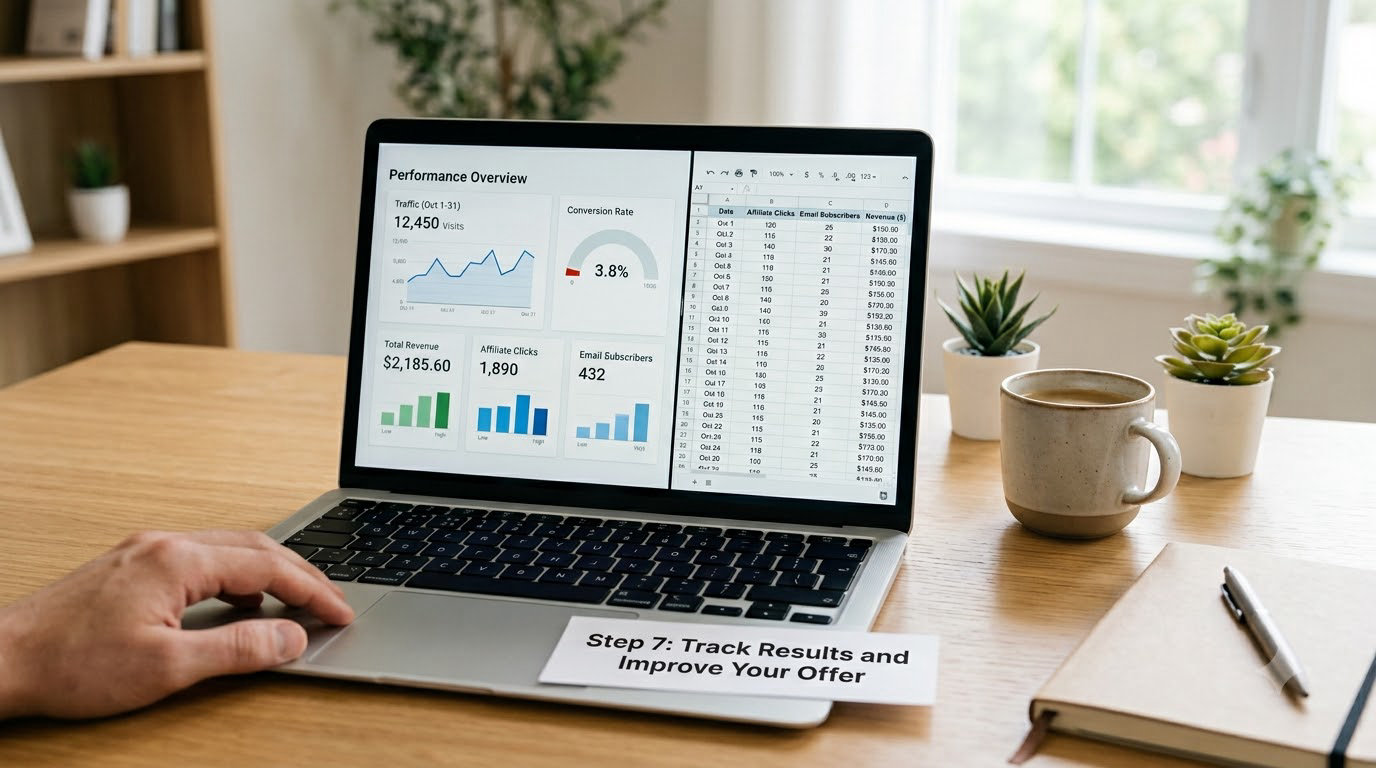
Most bloggers fail here because they check pageviews. Pageviews are not money. These four numbers are.
Clicks on your money links, from your own analytics or your affiliate dashboard. Conversions, which is clicks that became sales or sign-ups. Revenue, total money in, by source. And revenue per post, which is the one that tells you where to spend your next month.
Do the arithmetic honestly: sessions multiplied by conversion rate multiplied by commission gives expected income. Plug in your real numbers every month and the picture stops being a mood.
Then look for the leak. Clicks with no conversions usually means the recommendation is weak or the page has no reason to buy. Conversions with a high refund rate means the product oversold. Lots of traffic and no email sign-ups means the opt-in is buried.
Improve one thing at a time: a better first paragraph, a clearer price, one more proof point near the buy button, or a follow-up post aimed at the same problem. Small changes compound. Big rewrites usually waste a month.
Common Mistakes
Promoting too many unrelated products. Twenty links on a page reads like a catalogue and converts like one. Five things you genuinely use will earn more than twenty you merely carry.
Choosing only for commission size. A 60 percent rate on something nobody in your audience wants beats nothing, because it does not sell.
Hiding the affiliate relationship. A disclosure near the top of the post, and proper link attributes, is both the honest choice and the compliant one. Undisclosed affiliate income is a real legal problem, and it is the fastest way to lose a community you spent years building.
Making earnings claims you cannot back. Screenshots of sudden income make readers suspicious of everything else you say. Describe your method and your real numbers instead, including the slow months.
Selling to an audience that does not fit. If your readers are beginners learning a hobby, they will not buy enterprise software. Check that the buyer and the audience are the same person.
Waiting for traffic before doing anything. Services and affiliate links work at low volume. Sitting still for a year waiting for ad-eligible pageviews is the most expensive habit in this whole list.
Skipping the boring pages. About, contact, privacy policy, terms and affiliate disclosure. They take an afternoon, they build trust, and they matter more than most people expect.
A few habits that keep the rest honest: separate business money from personal money from day one, keep receipts, and set aside a portion for tax as it arrives rather than in April. Tax rules vary by country and state and change often, so check with an accountant for your situation rather than copying someone else’s arrangement.
Frequently Asked Questions
Can a new blog make money without ads?
Yes, and services are usually the fastest route. A new blog with twenty focused posts can sell a setup session or consulting package before it has meaningful traffic, because buyers are checking your competence rather than your traffic number. Affiliate links and small digital products follow, usually within one to three months of consistent publishing. Set expectations low and treat the first few sales as proof the model works, not as income.
What is the easiest way to monetize a blog without ads?
Selling a service is the easiest, because you already have the thing being bought. Pick one offer, write a short page describing it, and ask for the sale in the posts where the topic comes up. Digital products are the next easiest once people keep asking you the same question, because a checklist or template takes a weekend to build. Affiliate marketing takes longer, since you need recommendations and trust in place before clicks convert.
Do I need a large audience to earn money from a blog?
Not for most ad-free methods. A few hundred readers who trust you can produce more revenue than tens of thousands of casual visitors, because services and digital products are priced on usefulness rather than on impressions. Affiliate income scales differently, so it needs more sessions to move the same amount. The practical answer is to build depth first: a small audience that acts beats a large one that scrolls.
How long does it take to monetize a blog without ads?
It depends entirely on which method you pick. Services can produce a payment within a few weeks of publishing enough to show you can do the work. Affiliate links usually need one to three months of steady traffic and a handful of trusted recommendations. Digital products often take three to four months because of the building and validating stage, and memberships take longer still since renewals need time to compound.
Should I disclose affiliate links and sponsorships?
Yes, clearly and above the links. In the US the FTC expects affiliate relationships to be disclosed so a reader can weigh what you say, and sponsored content has to be identified as paid. A short plain sentence near the top of the post, plus proper link attributes, covers most cases. Undisclosed affiliate income can trigger enforcement and permanently damage traffic to every page you have.
Do bloggers need a business license or pay taxes on blog income?
Rules differ by country, state and local authority, so treat any general answer as a starting point only. Blog income is usually taxable, and payments above certain thresholds may produce a form you receive. Some locations require a registration or licence depending on what you sell and whether you are operating as a business. Keep records from your first payment and ask a local accountant what applies to you specifically.
How to Make Money from a Blog Without Ads: Start Here
Pick one audience problem and publish until you can show you solve it. Then put up a single service page, because that is the fastest ad-free dollar on the table. Add affiliate recommendations only where you already use the product, and validate a digital product with a waitlist before you spend a weekend building it.
None of this pays quickly, and anyone promising otherwise is selling something. What it does is compound into an income stream you own, on a site you control, with no ad network in the middle.
1 thought on “How to Make Money from a Blog Without Ads (October 2026)”