
Most people underestimate this one. A personal blog can run for a couple of hundred dollars a year, a small business site usually lands somewhere between $700 and $2,500, and an online store or high-traffic site runs well into five figures. The wide gap isn’t about greed, it’s about traffic, features and how much human work you buy.
I’ve helped small businesses price their annual site budget for years, and the same pattern keeps repeating: the build quote gets all the attention, then the first renewal invoice arrives and nobody budgeted for it. This guide prices the running side properly, line by line.
Table of Contents
How Much Does It Cost to Run a Website Per Year?
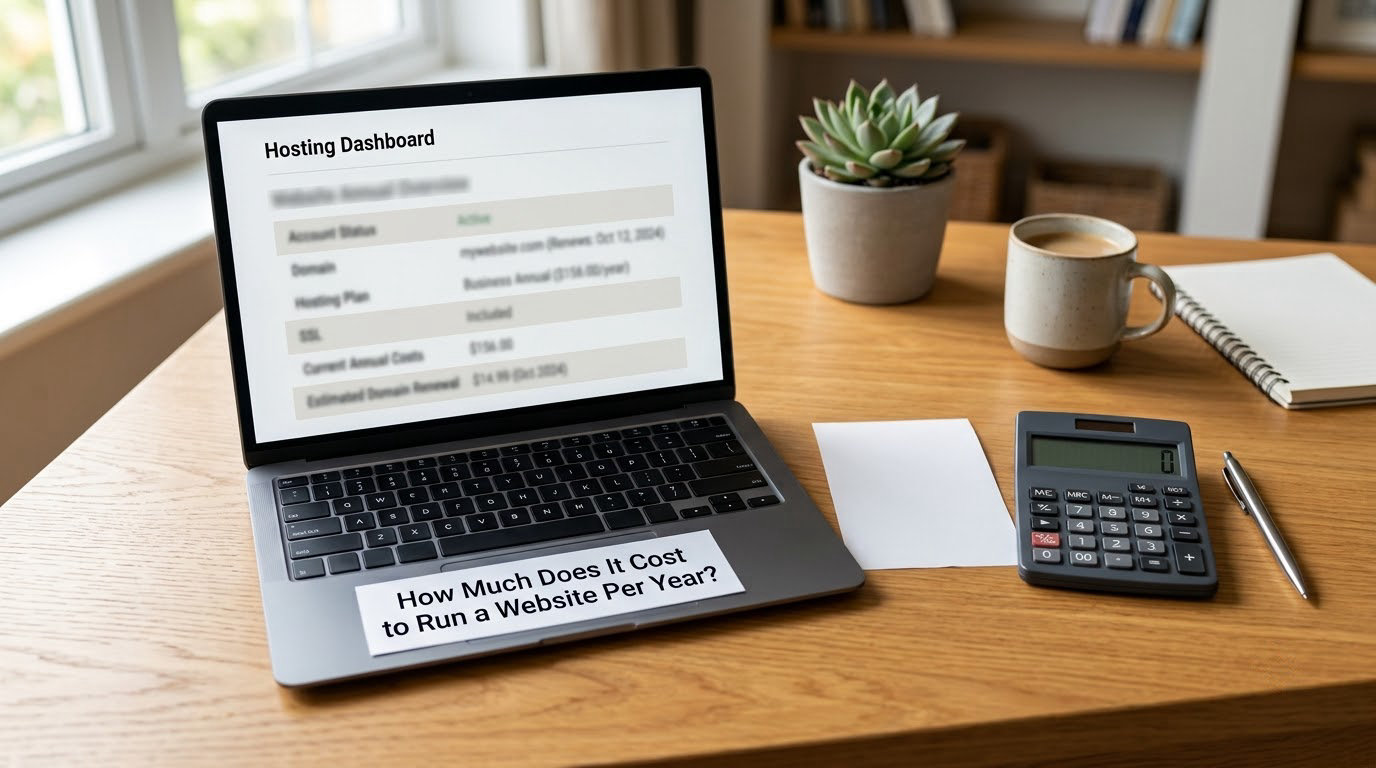
How much does it cost to run a website per year? For a hobby blog or portfolio, budget roughly $50 to $250. For a small business website, $700 to $2,500 is the realistic band. For an online store or a site with serious traffic, $5,000 to $15,000 or more.
Those are typical US ranges. They vary by region, by provider, by the specifications you pick, and they change over time, so treat them as planning numbers rather than quotes.
Here is what a typical year actually contains. Every figure below is annual, not monthly.
| Cost line item | Typical annual cost | DIY or paid | Required or optional |
|---|---|---|---|
| Domain registration and renewal | $10 to $60 | DIY | Required |
| Web hosting | $0 to $2,400 | DIY | Required |
| HTTPS/SSL certificate | $0 to $250 | DIY | Required |
| Business email | $0 to $300 | Either | Usually required |
| Backups and staging | $0 to $200 | Either | Recommended |
| Security monitoring | $0 to $400 | Either | Recommended |
| Theme and plugin licences | $0 to $500 | Either | Optional |
| Maintenance and updates | $0 to $6,000+ | Paid if not DIY | Required |
| Content, SEO and marketing | $0 to $20,000+ | Paid | Optional |
Two things stand out. First, SSL is not a separate bill anymore: Let’s Encrypt and Cloudflare issue free certificates, and managed hosts include them by default. Second, the last two rows are where small businesses actually get surprised, because the technology is cheap and the labour is not.
On a side note, register the domain in your own name, not your designer’s. It costs nothing to do it right and it costs a lot to fix later.
How Much Does It Cost to Run a Website Per Year by Website Type?
A blog and a store share the same three core bills, but everything else scales differently. This is how each type breaks down.
| Website type | Low scenario | Middle scenario | High scenario |
|---|---|---|---|
| Personal blog or hobby site | $50/yr | $120/yr | $300/yr |
| Portfolio site | $120/yr | $350/yr | $900/yr |
| Small business website | $700/yr | $1,600/yr | $2,500/yr |
| Online store | $2,000/yr | $6,000/yr | $15,000+/yr |
| High-traffic or SaaS site | $5,000/yr | $20,000/yr | $100,000+/yr |
The personal blog low case is a static site on free or near-free hosting with a $12 domain. The middle case adds a paid theme and a couple of plugin subscriptions. The high case means a managed host, professional email and someone doing monthly updates.
A portfolio site runs slightly higher because of image weight and, often, a paid licence for a page builder or a theme. Freelancers quote in this range constantly, and they usually fold basic edits into it.
For a small business site, the low scenario assumes the owner handles updates. The middle scenario assumes a freelance retainer plus a small content budget. The high scenario includes regular copywriting and some SEO work. Practitioners on WordPress-focused forums commonly report maintenance retainers in the $30 to $125 per month range per site, which is $360 to $1,500 a year before content.
Online stores add three things nothing else has: payment processing, product photography and inventory updates. Processing fees are percentage-based, so they scale with revenue rather than with effort. On $250,000 in annual sales at roughly 2.9% plus a flat per-transaction fee on each order, that’s roughly $7,250 in fees plus per-order charges before a single ad is bought. No amount of hosting optimisation touches that line.
High-traffic sites add infrastructure: CDN, larger databases, load balancing, monitoring and usually a DevOps engineer. That’s why the high column jumps by an order of magnitude.
What Affects the Price?
Nine factors move the number more than anything else. Knowing which ones apply to you is most of the budgeting work.
Hosting type. Shared hosting starts around $50 a year and can handle a small business site comfortably. VPS hosting starts around $200. Managed WordPress hosting usually runs $300 to $600. Static hosting for a site with no database is $0 to $100. A dedicated server is thousands a year and only makes sense above a certain traffic level.
Traffic and bandwidth. Most hosts advertise generous bandwidth, then throttle or suspend heavy sites. A blog with 2,000 visitors a month is nothing. A resource-heavy site with 200,000 visitors a month will outgrow shared hosting and outgrow the price of shared hosting too.
Storage and database size. Media libraries grow quietly. A site that adds 20 GB of product photos a year will outgrow a small plan and force an upgrade.
Domain choice. A .com sits at $10 to $15 a year for the first term, sometimes a few dollars more on renewal. A .co, .io or .ai can run $25 to $60 a year, and premium domains run hundreds. Check the renewal figure, not the first-year figure.
Email accounts. Google Workspace runs about $7 per user per month, Microsoft 365 Business Basic about $6, and hosted mailboxes from your web host are cheaper. A five-person company pays $300 to $420 a year just for inboxes.
Store features. Subscriptions, bookings, memberships, multi-currency and abandoned-cart recovery all add either a plugin licence or a platform plan increase.
Security and backups. Paid malware scanning, a web application firewall, uptime monitoring and off-site backups each add tens to hundreds of dollars a year. Most hosts bundle basic versions if you pick the right plan.
Content. Copywriting runs roughly $50 to $200 per page, and a small business publishing four pages a quarter turns that into a real line item.
Who does the work. This is the biggest lever of all. Freelancers commonly charge around $75 an hour and agencies $100 to $150, and a care plan bundles that into a monthly figure. Some agencies report charging $1,500 to build a site plus $125 a month for hosting and maintenance combined, then still losing the client to a cheaper builder plan because the total is higher.
Ways to Save
You can cut a surprising amount without creating a reliability or security problem. The trick is knowing which costs are load-bearing.
1. Use shared hosting when you actually can. A brochure site or small business site with modest traffic does not need a VPS. Start shared and move up only when the host tells you to.
2. Buy a multi-year domain, but read the renewal clause first. Three years up front can cut the effective annual rate noticeably, though you’ll pay the current rate when it expires, and the registrar cannot hold your price forever.
3. Bundle where the bundle is honest. Domain plus hosting plus email from one provider is often cheaper than buying each separately, and it removes one support queue. Compare the bundled total against the sum of the parts, not against one line.
4. Use free email carefully. Routing through a free consumer mailbox costs nothing and looks unprofessional on a business site. It’s fine for a hobby blog, rarely fine for anything revenue-generating.
5. Audit paid plugins once a year. Most sites carry subscriptions for tools the owner stopped using in year one. Every unused paid plugin is money you’re renewing for no reason.
6. Keep automated backups. Off-site backups cost almost nothing through the host or a storage bucket. Paying a developer to rebuild a site you could have restored in an hour is the expensive version of this.
7. Learn the routine updates. Updating WordPress, a theme and a handful of plugins takes about twenty minutes and a short guide. Doing it yourself replaces the most common maintenance line item. Keep a tested restore path before you touch anything.
8. Fix the renewal price before you sign. This is the one people skip. Introductory hosting and builder pricing is a discount on year one only, and the jump at renewal is the single most common surprise people report on forums. Find the year-two price, in writing, before you commit.
Frequently Asked Questions
Can I run a website free of cost?
Yes, for a simple site. A static site built with a generator like Jekyll or Hugo, hosted on GitHub Pages, Cloudflare Pages or Netlify at their free tiers, with a domain at $10 to $15 a year, runs for about that domain fee alone. Free means no database, no plugins and no WordPress admin. If you need contact forms, memberships or a shop, free hosting tiers get painful quickly and paid hosting is the cheaper answer.
What’s the cheapest way to run a website per year?
The cheapest realistic annual budget is roughly $50 to $150: about $12 for a domain, $0 to $30 for hosting on a free or entry tier, and $0 for SSL, which free certificate authorities issue at no cost. Keep it cheap by staying on shared or static hosting, using free page builders, skipping paid plugins and doing the monthly updates yourself.
How much does it cost to maintain a website every year?
For a small business site, $700 to $2,500 a year covers domain, hosting, email, security, backups and regular maintenance. Add $1,000 to $5,000 more if you pay for new content or SEO work each year. A hobby blog can be maintained for well under $200 a year because the labour is your own time.
How much should a small business pay for a website each year?
Set aside $700 to $2,500 a year for a typical small business website, and more if you publish new content regularly. If an agency quotes a figure well below the combined cost of hosting, email, backups and maintenance, ask what is excluded. Under $500 a year usually means you are the one doing the work.
How much should I pay someone to manage my website?
Freelancers commonly quote $30 to $75 a month per site for core maintenance, rising to $50 to $125 when the site includes an app or app-like layer. Agencies quote higher, often $125 to $500 a month. Individual edits get billed by the hour at roughly $75 for freelancers and $100 to $150 for agencies, often with a half-hour minimum, which is why a flat care plan is often better value.
Is 1,500 dollars a good price for a new website?
For a small business site of 5 to 10 pages built on a template or a page builder, yes, that sits in the normal US range. Ask whether design, copywriting, hosting setup, training and the first year of maintenance are included. Remember the quote is one-time; the running budget still starts the month after launch.
Conclusion
So, how much does it cost to run a website per year? Under $250 for a hobby site, $700 to $2,500 for a small business, and $5,000 upward once transactions and traffic are involved.
Before you pick anything, write down the features you genuinely need, then split the list into what keeps the site running and what would be nice. Compare the year-two renewal price, not the first-year offer, and make sure the domain is registered in your own name. That one afternoon of work usually saves more than any discount hunt.